

By Prof. Rosalind Cornforth; Director of The Pearl
This is where climate policy gets made.
SB64 in Bonn is quieter than COP, smaller rooms, fewer cameras and honestly I find that a relief. More than that. Energising.
Today, across the Baku Dialogue on Water for Climate Action, the GEF-9 Programming and Policy Directions and Adaptation Strategy session, and the Sharm el-Sheikh joint work on agriculture and food security, one issue ran through all of it; the gap between what we are trying to do and what actually reaches communities is fundamentally an evidence gap.
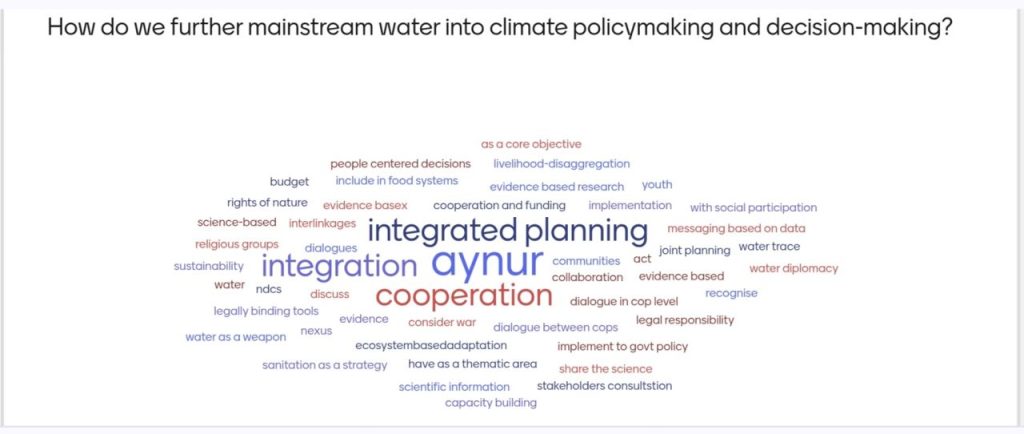
At the Baku Dialogue, one point came through clearly: for much of the world, climate reach people first through water, through drought, flooding, and variable rainfall. And yet, the integrated climate, hydrological and livelihoods evidence that communities need to understand their real options, the place-based, plausible futures that our ICICLE storylines approach brings together from the bottom up, is still largely absent where it is most needed.
The GEF-9 session reinforced this: a new emphasis on integrated programming across water, food systems and nature-based solutions, single-step access and shared accreditation across climate funds. Fragile and conflict-affected contexts are now named as an explicit cross-cutting priority in Global Environment Facility (GEF) adaptation programming, which for the communities we work with is significant.
Wonderfully rich conversations today with colleagues across water, adaptation finance, Green Climate Fund, Pacific NAPs, and food security – we are all working on the same problem from different angles, and days like this, well they simply remind me why it matters, why I get out of bed in the morning!
As one of the eight founding World Climate Research Programme (WCRP) My Climate Risk regional hubs, The Pearl at the University of Reading works with communities, partners and implementing organisations to generate integrated climate, hydrological and livelihoods science, that starts where people live and supports the decisions they need to make. As accredited RINGO observers we are trying to make sure that evidence finds its way into the right rooms.
Looking forward to our joint London Climate Action Week event with Microsave Consulting (MSC) at the National Institute of Economic and Social Research (NIESR)on Wednesday 24 June, where we will be bringing these conversations on adaptation finance and community-level evidence together with colleagues from the insurance sector and beyond.