

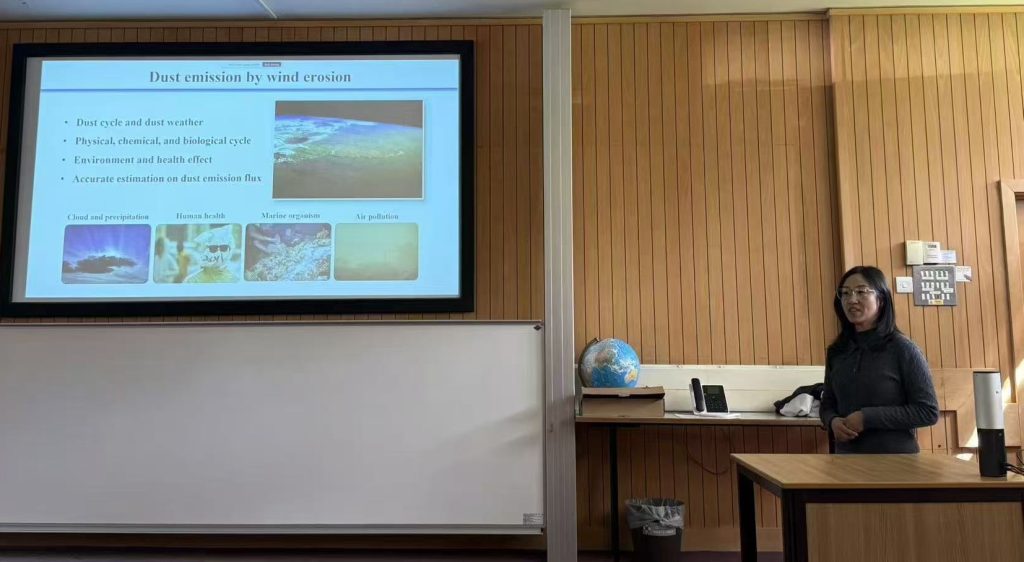
As part of her year‑long visit with The PEARL, we are delighted to highlight a recent seminar delivered by Dr Xiaolan Li in the Department of Meteorology. Dr Li is a Senior Researcher at the Institute of Atmospheric Environment, China Meteorological Administration (CMA), and her visit to Reading provides valuable opportunities for academic exchange across departments.
In this seminar, Dr Xiaolan Li presented research on the characteristics and parameterisation of different dust emission mechanisms, drawing on extensive field observations and modelling studies from northern China. Her talk examined how dust aerosols are generated at the sandy land surface and why detailed representation of these processes is critical for improving atmospheric models and dust storm prediction.
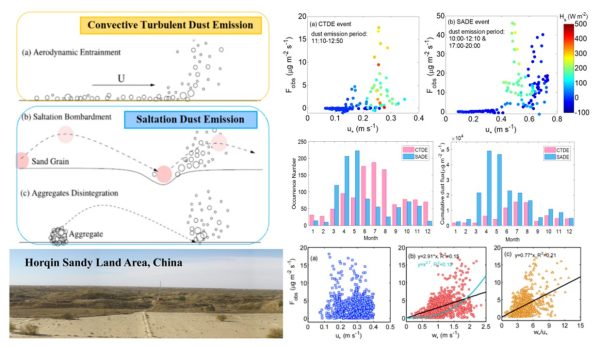 Focusing on long‑term observational campaigns in the Horqin Sandy Land area, Dr Li compared saltation‑driven dust emission with dust uplift driven by convective turbulence. She showed that thermodynamic instability and surface heating can produce significant dust emissions even under relatively weak wind conditions, in the absence of the saltation activity by sand grains and/or aggregates, challenging conventional threshold‑based modelling assumptions.
The seminar also addressed how these findings are being incorporated into improved parameterisation schemes, highlighting the value of combining mechanical and thermally driven processes to produce more realistic simulations of sand and dust events. The session prompted discussion on the wider implications for weather forecasting, climate projections, and air quality research, and offered an engaging opportunity for staff and students in Meteorology to interact with field‑based atmospheric science.
Dr Li’s visit to The PEARL continues to foster collaboration and knowledge exchange across disciplines, and her contribution to departmental seminars such as this one exemplifies the added value of hosting visiting academics within the University. We look forward to further opportunities to engage with her research during her time in Reading.