

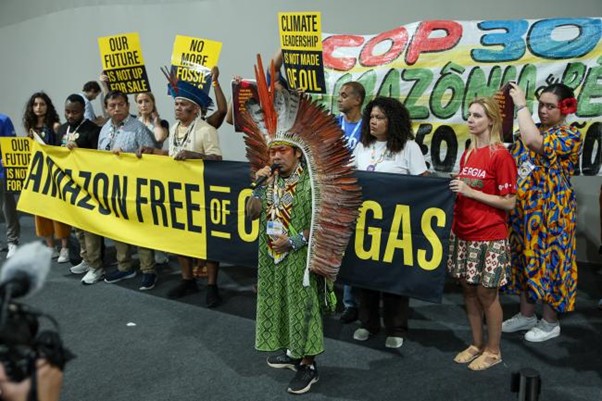
Protest at COP against oil and gas projects in the Amazon. Photo by IISD/ENB | Mike Muzurakis
Written by Jaylen Vicol, a Doctoral Researcher, SCENARIO DTP, COPCAS participant, University of Reading.
Brazil’s left-left leaning president Lula said that COP30 would be dubbed the “COP of Truth”. Coming from a place of frustration with a political climate that values truth less and less: where the loudest voice takes the place of truth, he hopes to let reality take centre stage during this year’s discussions.
Nowhere brings that reality into focus like Belém, COP30’s host city positioned at the boundary of the Amazon Rainforest: a biodiversity hotspot under increasing pressure from deforestation and climate change.
And who could better represent this region than the indigenous peoples themselves who call these rainforests their home?
On arrival to COP30, this year’s delegates were greeted by the Guajajara people of Maranhão, a neighbouring state, performing a ‘welcome song and dance’– as the BBC reported. However, I couldn’t help but question- will Indigenous people truly be heard, or will their presence amount to little more than a spectacle?
COP30 has set a record for Indigenous participation, with around 3000 delegates participating in discussions. Of these, roughly 1000 secured entry to the Blue Zone, the space wherein official negotiations take place, giving them a presence in the room where it happens.
However, it’s worth noting that fossil fuel lobbyists far outnumber them, making the second largest group this year, second behind only the Brazilian delegation in its entirety.
Their prominence illustrates the wider political climate well. Only months before the summit, a bill was blocked that would have represented Brazil’s most significant environmental rollback in decades.
The legislation aimed to weaken the environmental licensing system, permitting infrastructure projects, such as oil exploration, to advance with faster, less rigorous evaluations of environmental impacts. Not only this, the impact on hundreds of indigenous lands without formal recognition would entirely be neglected.
Despite the last-minute veto, the political climate remains in favour of fossil fuel development. Just last month, President Lula stated that “newly ongoing exploration for oil in the Equatorial Margin could finance the green energy transition” .
This exploration has been actively condemned by activist and environmental groups such as Greenpeace and WWF on grounds that the project may increase regional instability, put ecosystems at risk, and displace indigenous communities.
So, when President Lula says, “we will not give up a resource that can improve the lives of the Brazilian people”, we’re forced to question whose futures are being considered, and who’s being overlooked.
Inside the Blue Zone, this tension is echoed by COICA, the Coordinator of Indigenous Organizations of the Amazon Basin. While the newly announced Tropical Forests Forever Facility seeks to financially incentivise the maintenance of Tropical Forests, COICA challenges the stipulated minimum funding for Indigenous Communities, asking “Why only 20%?”
They continue: “They are our territories, and decisions must be made with [Indigenous] participation and ancestral knowledges [to prevent] displacement, conflict and biodiversity loss”.
They also emphasise the necessity of “amplifying the access to direct management [by] Indigenous peoples and local communities throughout the implementation”.
As the pressure inside the venue increased, so did frustrations outside. On the evening of Tuesday 11th, fuelled by desperation of their fight while facing exclusion from key negotiations, dozens of activists forced their way into the Blue Zone.
“We want our lands free from agribusiness, oil exploration, illegal miners and illegal loggers.” explained Nato, speaking as a leader from the Tupinambá community.
Today, Thursday 13th, has marked a continuation of demonstrations. A group of around 90 individuals, representing the Munduruku people, blocked the entrance to the conference, causing delays and forcing delegates to enter through side routes.
Captured on a Reuters livestream, one woman articulated the wider sentiment shared across Indigenous communities:
“You need to hear us. Speak with us. They don’t negotiate with us. They want us silenced. We want our forests standing. They don’t understand how they destroy the rivers. We need to protect our territory for our children”.
Will these demonstrations serve as a wake-up call for decision-makers, or will Indigenous voices continue to be side-lined within negotiations? And if structural change doesn’t materialise, their presence may yet again be symbolic rather than substantive.
With so much uncertainty, what is abundantly clear is the depth of frustration, summarised in that same woman’s call for “an end to colonisation of our territory, our people, and our minds.”