

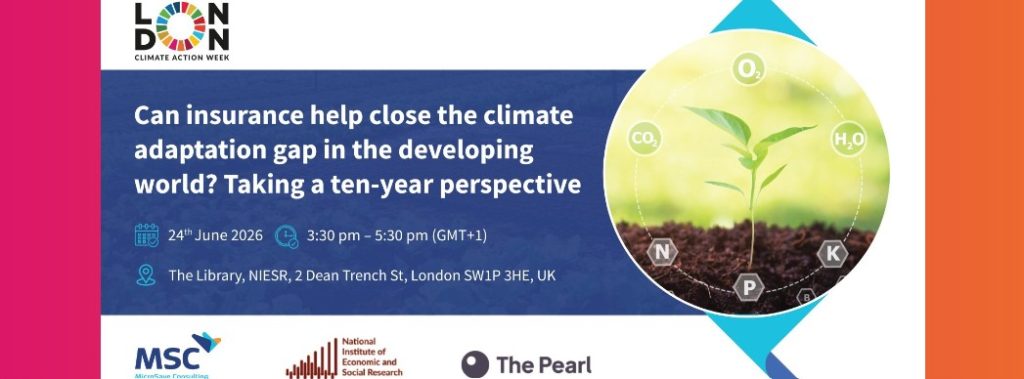
Date: 24Th June, Wednesday
Time: 3:30 PM to 6:30 PM
Venue: The Library, National Institute of Economic and Social Research (NIESR), 2 Dean Trench St, London SW1P 3HE
Limited seats! Registration is required.
The Pearl at the University of Reading is pleased to be co‑hosting a roundtable discussion during London Climate Action Week 2026, in partnership with MSC (MicroSave Consulting) and the National Institute of Economic and Social Research (NIESR).
This Chatham House roundtable, titled “Can insurance help close the climate adaptation gap in the developing world? Taking a ten-year perspective,” will bring together leaders from across the climate, research, policy, development finance, and insurance communities.
Why this conversation matters
Climate risks are intensifying rapidly, placing increasing pressure on vulnerable communities and exposing a significant gap between adaptation needs and available support. Insurance and broader risk financing mechanisms have the potential to play a crucial role in strengthening climate resilience, yet, their effectiveness, accessibility, and scalability remain key challenges.
This event will take a long-term, strategic view, exploring how climate risk protection systems can evolve over the next decade to better support adaptation in developing countries, and what actions are needed today to enable that transition.
What to expect
- Insightful discussion on the role of insurance and risk financing in climate adaptation
- Perspectives from policy, research, and industry experts
- A forward-looking dialogue on scaling solutions for resilience over the next ten years
- Opportunities to connect and exchange ideas with peers across sectors
The discussion will be held under the Chatham House Rule, encouraging open and candid exchange, and will be followed by networking.
This event reflects The Pearl’s commitment to advancing evidence-based, inclusive approaches to climate resilience and sustainable development, working collaboratively across sectors to address global challenges.