
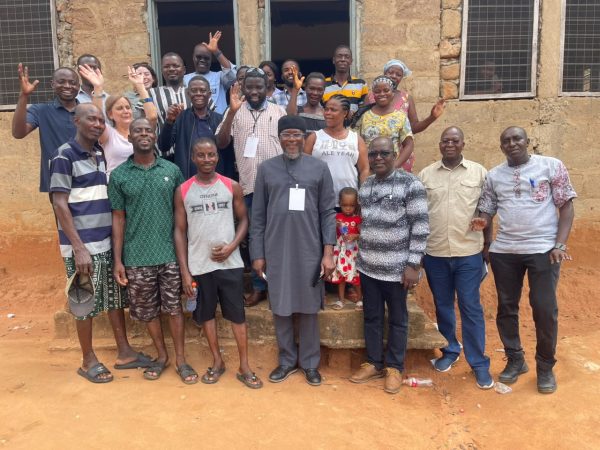
Summer School trainers, trainees and community members taking part in a wealth group discussion outside the church hall in Saforo, part of the Summer School’s fieldwork day applying the Household Economy Approach in practice.
The Pearl has completed delivery of a summer school in My Climate Risk, resilience and adaptation methods for AGRHYMET, the WMO regional training centre based in Niamey, Niger. The training was held at the Ghana Space Science and Technology Institute (GSSTI) in Accra from 1-11 September 2026, core partners of The Pearl. The programme was funded by the World Bank within their Food Security and Resilience Programme (FSRP) for the Sahel, and led by Professor Rosalind Cornforth, Director of The Pearl. It builds on The Pearl’s ongoing and long-term “Strengthening AGRHYMET’s Training Programme” partnership.
The Summer School followed a train-the-trainer model, designed so that AGRHYMET staff can go on to teach and carry out research using the WCRP “My” Climate Risk (MCR) approach, and the ICECCAP framework pioneered by The Pearl to put it into practice. ICECCAP is built around iterative, inclusive engagement with Integrated Climate-Livelihood-Environment storylines (ICICLEs) at its core (Wells et al. (2023), Frontiers in Climate). AGRHYMET colleagues worked through this framework across the programme, analysing climate storylines, learning the Household Economy Approach (HEA; Evidence for Development), and applying adaptation options scoring, using the ClimTip livelihood zone ML11 in southern Mali as a working case study throughout.
For several participants, whose training and daily work lie chiefly in climate science, a defining part of the school was direct exposure to fieldwork and to HEA in practice. Working through quantitative livelihoods data alongside climate data gave participants a clearer sense of what integrating the two strands actually involves, and why climate information on its own cannot capture the full picture of risk. That shift, from treating climate projections as an end point to treating them as one input into a wider livelihoods and vulnerability picture, was among the most significant outcomes of the ten days.
Across the programme, participants moved from foundational work on climate model uncertainty and data, through fieldwork-based livelihoods measurement, before bringing the strands together in an integrated ICICLE storyline and synthesis module. The closing days focused on scoring adaptation options and translating storylines into practical guidance, with participants building worked examples across a range of future climate scenarios.
The Summer School was hosted by GSSTI, whose team took part alongside AGRHYMET colleagues throughout the programme. This work reflects The Pearl’s role as a WCRP My Climate Risk Global Regional Hub, and builds on our track record of capacity building within the AGRHYMET region.
Further information
Read more about The Pearl’s work with AGRHYMET
Learn more about My Climate Risk
Learn more about our interdisciplinary capacity building arm, The Pearl Academy
Learn more about the World Bank’s Food System Resilience Program