
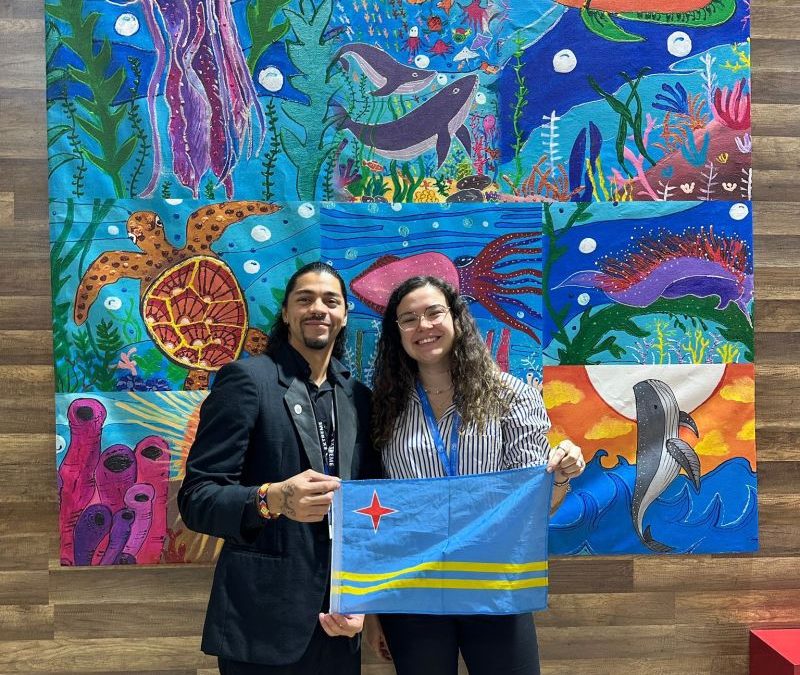
Written by Lynn De Miranda, a Doctoral Researcher at the University of Reading.
One of the absolute highlights of my COP29 experience was the many islander voices I heard. Despite the many languages spoken, there was an undoubtable kinship. Many islanders had different experiences but the story they told had a similar message: Islands and their people are often dismissed as unavoidable victims of the tragic effects of #ClimateChange. We cannot let this happen. Without our presence those with other views will shape outcomes.
It often feels like #Island nations are underrepresented and left out of important conversations, despite our islands often providing the most sobering imagery of climate effects. One example of this that I see regularly is the imagery of the map of islands such as the Maldives, overlayed with red to highlight what areas would be lost in the 3-meter-sea-rise situation. In this figure (which if you haven’t seen it, I suggest you look up) it becomes clear that the affected areas are significant. Not only in terms of land loss but in terms of livelihood loss and culture loss- the last two rarely mentioned.
While attending a side event hosted by Island Innovation I was reminded by Nigel Maduro (pictured), an activist, representative of the #Caquetío community and proud #Arubiano, of our cultural ties to our islands. He mentioned a beach where “every Aruban learned to swim” and although this beach was referenced in terms of the issues with land overdevelopment, it made me reflect. This beach was indeed also where I learned to swim and where our children get brought during school swim practice. I realised that this beach not only meant something to me personally, but it was also enshrined into our culture and our identity.
In a 3-meter scenario this beach would most likely be gone, consumed by the waters that we grew up with. And although I am sure our grandchildren would find other places to teach their children to swim (islanders are resilient in that way), that connection and commonality to their ancestors would be lost.
I heard stories similar to Nigel’s echoed throughout my time in Baku, stories of kinship and bravery. Stories of people who are fighting every day, not only for their islands but for their culture and livelihoods. I saw people raising their voices, not only in the halls of the #COP29 venue but in the meeting rooms, negotiation rooms and even on centre stage at the Leaders’ Summit. I saw people harnessing innovations to drive adaptation efforts. I saw communities embracing change and becoming involved in policy. I saw indications of “bottom-up” approaches, and sure signs of financial interest from varied sources.
And although the outcomes of COP29 were disappointing to many, myself included, I found my heart full of passion and glimmers of optimism. COP29 showed me that Islanders regardless of island are resilient and incredibly driven to adapt, and the world is slowly waking up to the fact that islanders are not “just inevitable victims of climate change”. I am extremely grateful to the Walker Institute for supporting me to attend COP29 in person.